
GAS BASED FIRE SUPPRESSION
The sprinkler heads are frangible bulbs filled with a liquid that, when heated, expand causing the bulb(s) to break and the system to release water. The water from the sprinkler head will cover the area where the fire is located and will continue to operate until the fire department can fully extinguish the fire.
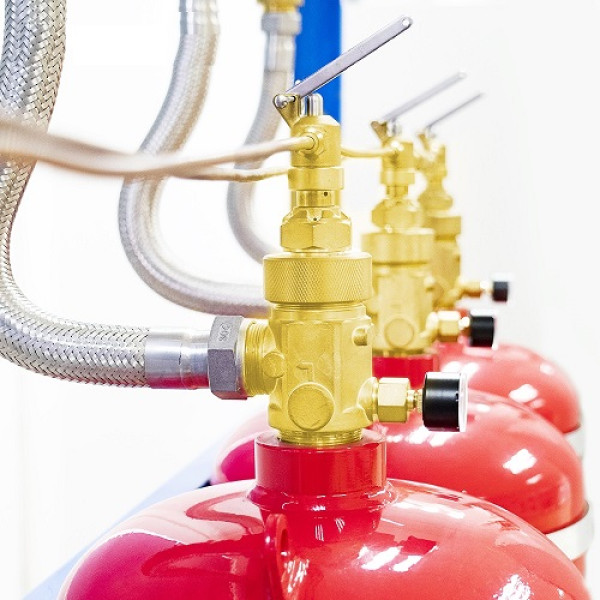
FM 200
- INTRODUCTION
- FEATURES
FM-200™ (HFC-227ea) is formed from the elements carbon, fluorine and hydrogen (CF3CHFCF3-heptafluoropropane). The primary extinguishing mechanism of FM-200™ is heat absorption, with a secondary chemical contribution from the thermal decomposition of FM-200™ in the flame.
FM-200™ fire suppressant (HFC-227ea) can be safely used where people are present.
When used at standard design concentrations, it is safe for occupied spaces. FM-200™ leaves no residue. Most common metals, such as aluminum, brass, steel, cast iron, lead, stainless steel, and copper, as well as rubber, plastic, and electronic components, are unaffected when exposed to FM-200™ (HFC-227ea)
- Safe for human occupancy.
- Zero Ozone Depletion Potential (ODP)
- Discharges in 10 seconds or less to extinguish fires rapidly, minimizing damage to high-value assets.
- App ears on US Environmental Protection Agency (EPA) Significant New Alternatives Policy (SNAP) list
- Designed in accordance with NFPA 2001.
- UL listed and FM approved.
- Marine system with USCG and ABS approvals also available.

NOVEC 1230
- INTRODUCTION
- FEATURES
Shield Novec 1230 Clean Agent Fire Suppression Systems are highly efficient when combined with a properly designed plumbing network using the Shield version of the VDS Flow Calculation Software.
Novec 1230 Fire Suppression System for Industrial For industrial fire suppression used.
Novec 1230 fluid extinguishes a fire before it starts by rapidly removing heat. In a typical total flooding system, the fluid is stored as a liquid in cylinders pressurized with nitrogen. Automatic detection sensors trigger release when the fire is at the incipient stage, extinguishing it in mere seconds.
- Safe for human occupancy.
- Atmospheric Lifetime of <5 days, making Global Warming Potential (GWP) negligible
- Zero Ozone Depletion Potential (ODP)
- Appears on US Environmental Protection Agency (EPA) Significant New Alternatives Policy (SNAP) list
- Discharges in 10 seconds or less to extinguish fires rapidly, minimizing damage to high value assets.
- Designed in accordance with NFPA 2001.
- UL listed and FM approved.
- Marine system with USCG and ABS approvals also available.

INERT GAS SUPPRESSION
- INTRODUCTION
- FEATURES
NAFFCOInert® fire suppression system is an engineered system using with fixed nozzle agent and pipe network. NAFFCOInert® systems are designed in accordance with latest edition of NFPA 2001,”Standard on clean agent systems”. This system shall be designed for Class A, Class B & Class C application, it extinguish fire by reducing residual oxygen concentration to a level will no longer support combustion. The system can actuate by detection and control equipment for automatic operation along with providing local manual operation when needed.
NAFFCOInert® fire suppression system is particularly useful for suppressing fires in hazard areas where an electrically nonconductive medium is essential or desirable. Where the clean environment and the hazard obstructions require the use of a gaseous agent. It is an ideal replacement agent for Halon 1301 alternative.
PRESSURE REGULATOR TECHNOLOGY
Pressure Regulators modulate the discharge pressure to a constant 40-60 Bar which still delivers the design concentration within 60 seconds, but with significant performance and cost benefits:
BETTER SAFETY
- Prevents discharge freeze-up
- Prevents explosive force of discharge
SAVES TIME AND MONEY
- Enables low pressure manifolds & pipework to be used that are of lower cost and easy to install
- Reduces the difficulty and cost of locating/fitting pressure vents in the protected space
EASY MAINTENANCE
- After a system discharge, simply remove the regulator, recharge, and reconnect. No reconditioning necessary
- Functional tests are possible even while the SYSTEM IS ARMED